PHOENIX DIGITAL EXHIBITION

ResART

Resilience. Resistance. Art. And the possibility of beginning again…
ResART is a digital exhibition bringing together visual art, performance, music, food, and digital storytelling created by artists and “ordinary” people living and working across displacement, climate mobility, and return.
Enter Exhibition
About Visual Art Music Performance Tasting Memory Stories Leave a Response
Curatorial Intro

Beginning Again Through Art

Whatever forces the leaving —climate change, conflict, poverty, oppression, or most often the entanglement of all of these—displacement ruptures more than a place. It takes the everyday: the tastes and smells of a familiar life, the small routines that make a self feel possible, and, above all, the future—the aspirations, the plans, the right to dream forward.

ResART brings together painters, musicians, and people who have lived displacement from the inside, remaking livelihoods, rebuilding dreams, and imagining futures in places that were not chosen and remain uncertain. Their works and testimonies are not documents of suffering; they refuse the clean categories of victim and artist, crisis and creativity.

They are acts of resilience and resistance, works of art that are also acts of remaking—partial, ongoing, unfinished—and they are, stubbornly, a beginning.

Across image, sound, taste, and testimony, the exhibition follows the textures of response that emerge when ordinary life is interrupted by crisis, loss, or uncertainty. Some works dwell in disruption and grief; others turn toward memory, kinship, improvisation, and collective care.

Together, they ask how people continue, what they carry forward, and what art—including the art of preparing and sharing food—makes possible when familiar worlds are unsettled.

Developed within the PHOENIX project, ResART foregrounds artistic expression as a form of knowledge. It invites audiences to encounter resilience not as a slogan or personal trait, but as something embodied, relational, and creative — shaped by struggle, sustained by community, and oriented toward futures that remain open.
Dedicated to Margarita Olivera

This exhibition is dedicated to the memory of our dear colleague and PHOENIX partner, Margarita Olivera, Professora do Instituto de Economia at Universidade Federal do Rio de Janeiro, whom we lost in January 2026.

Section 02

Visual Art — Displacement & Belonging

The visual works gathered here approach resilience through image, form, and symbol. They make visible the emotional textures of displacement, memory, and persistence, showing how artistic practice becomes a way of holding together what has been shaken. This first “room” dwells in disruption—loss, instability, uprooting, and the pressure of altered worlds—while opening toward continuity and imagination.
Artist Spotlight

Nahrin Maliki

Printmaking ink and acrylic wash on paper
Nahrin Malki is a Syrian-born artist whose practice moves between painting, collage, and mixed-media work. Drawing on family archives, everyday scenes, and composite imagery, her work traces the entanglement of displacement, rural memory, and intergenerational care.

Children and elders recur across her images, standing at the threshold between past and present, vulnerability and endurance.

In ResART, we present two of her collections: “Home, Memory & Belonging” and “Stories of When Return Is Not Home”.

Home, Memory & Belonging

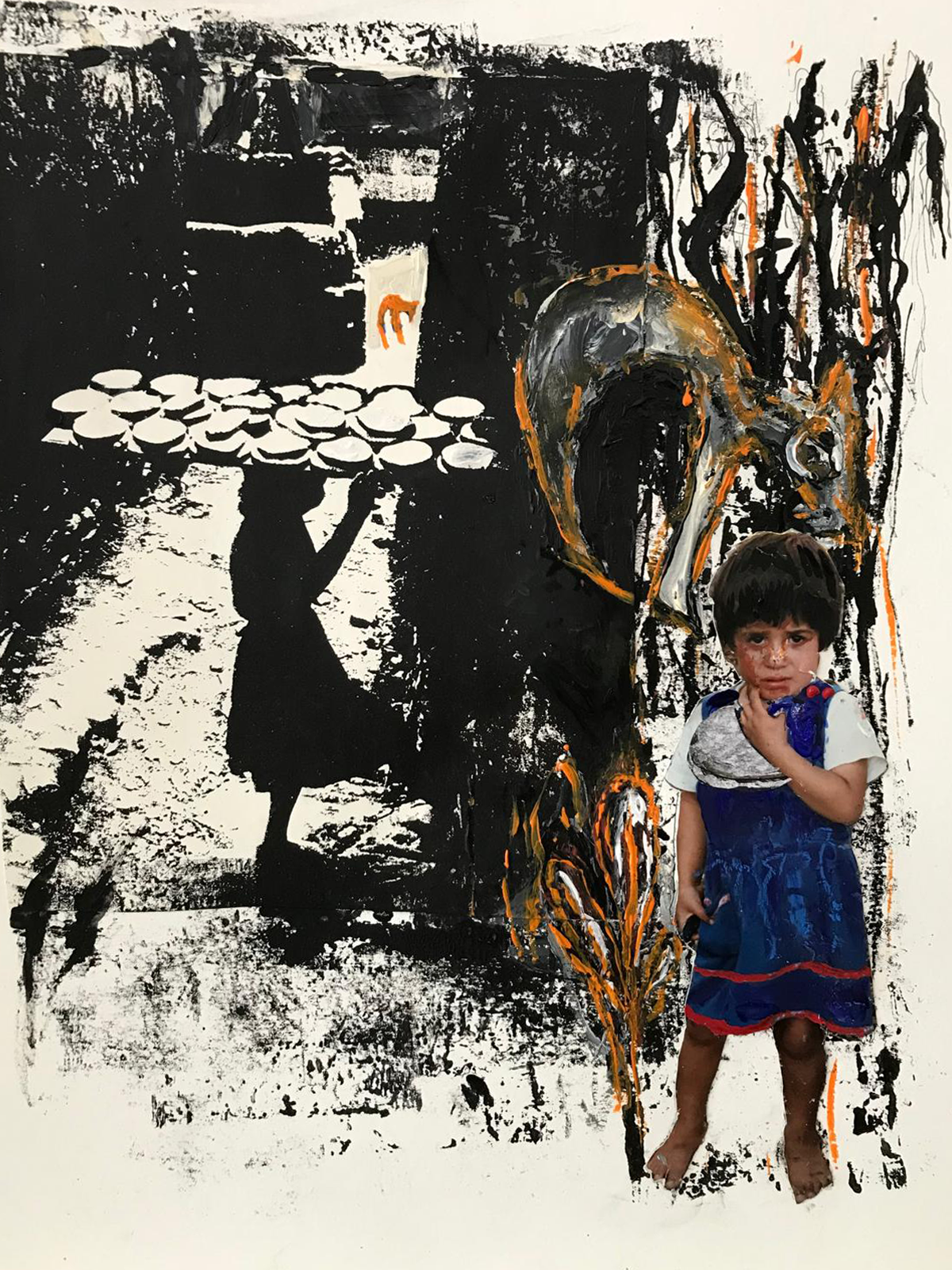
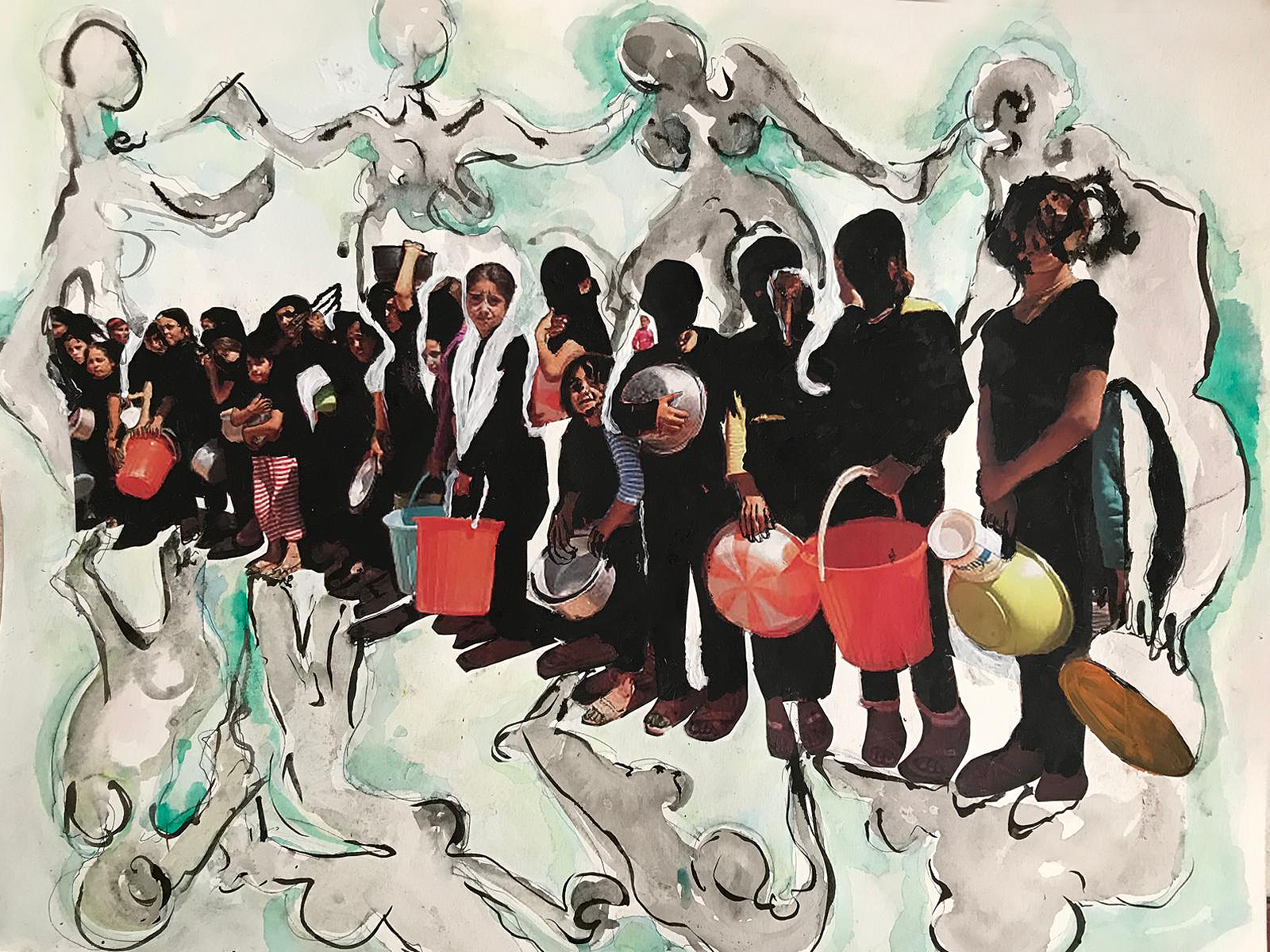
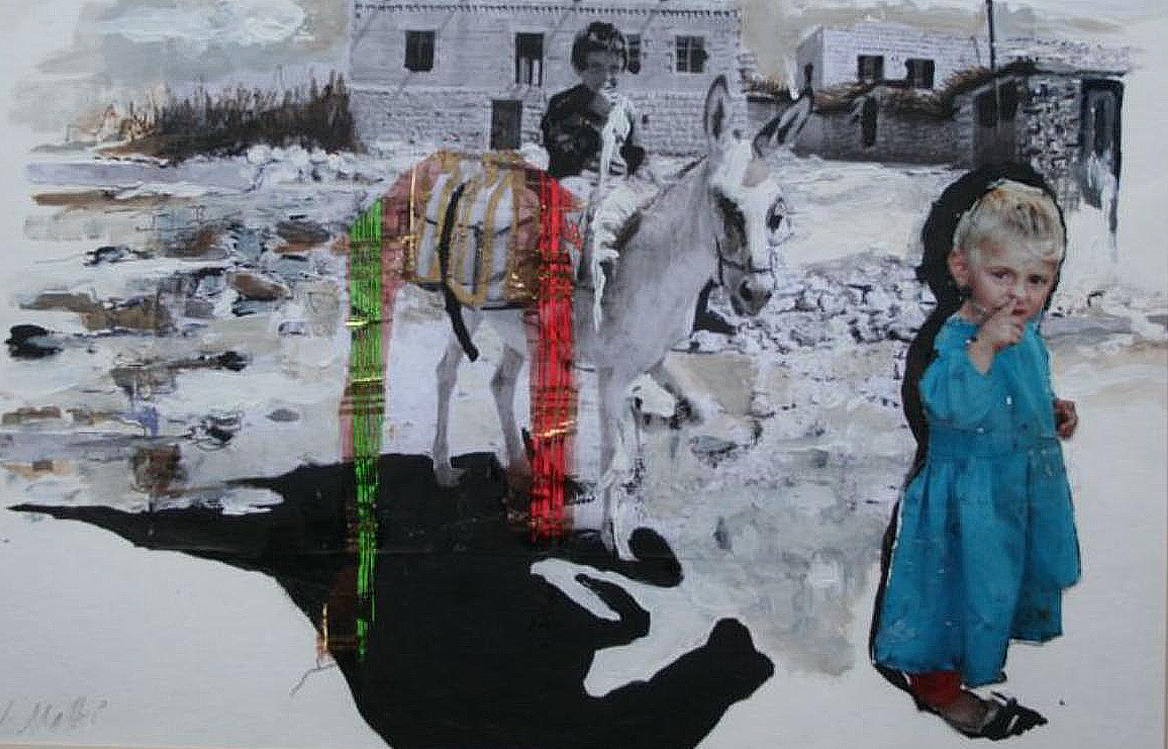
Nahrin’s first collection in ResART gathers fragments of everyday life—queues, courtyards, living rooms, rural paths—and reworks them into composite scenes where children and elders stand at the edge of past and present. The four pieces that follow trace resilience not as heroic recovery, but as a series of small, repeated acts: waiting together, carrying food, tending animals, holding memory. They invite viewers to dwell in these in between spaces, where vulnerability and endurance are inseparable.
VIEW⤢
Rooted Memory
The work evokes patient endurance and the long labour of remembering—rooted in land, story, and the scars of displacement. The work evokes patient endurance and the long labour of remembering—rooted in land, story, and the scars of displacement. Mixed media on paper, Nahrin Malki.
VIEW⤢
Balancing Acts
Everyday gestures become a quiet balancing act of care, danger, and continuity. Mixed media on paper, Nahrin Malki.
VIEW⤢
Waiting Lines
The scene captures collective resilience: queuing for survival, learning to wait together, and forming bonds in the shadow of humanitarian infrastructures.
VIEW⤢
Shadows of Home
The work layers home, absence, and the stubborn attachment to place.

When Return Is Not Home

Nahrin’s second collection in ResART gathers images which were created for a book about migrant narratives on return When Return Is Not Home: Voices of Migrants. Each illustration responds to the story of a person whose journey did not end with arrival in Europe but continued through deportation, circular movement, and uneasy returns. Here, five works are paired with brief notes that highlight a key emotion or tension in each story. The selected images were made in a consistent monochrome ink/wash style — loose, expressive, figurative. They prioritise visual-narrative resonance: where the composition, gesture, or symbolic content most powerfully speaks to a specific story's core emotion.
VIEW⤢
Kefaet – Surviving Deportation
Power, erasure, the indestructibility of music
Two heavy silhouettes loom over a crouching child figure, while three musical notes float free to the right. The image captures the asymmetry of power in deportation—institutions and uniforms standing over a person reduced to a file number. Yet the notes escape the frame: music as the part of Kefaet that cannot be deported, the voice that travels with him through the night time raid, flight, and forced arrival in a country he only knew from a map.
VIEW⤢
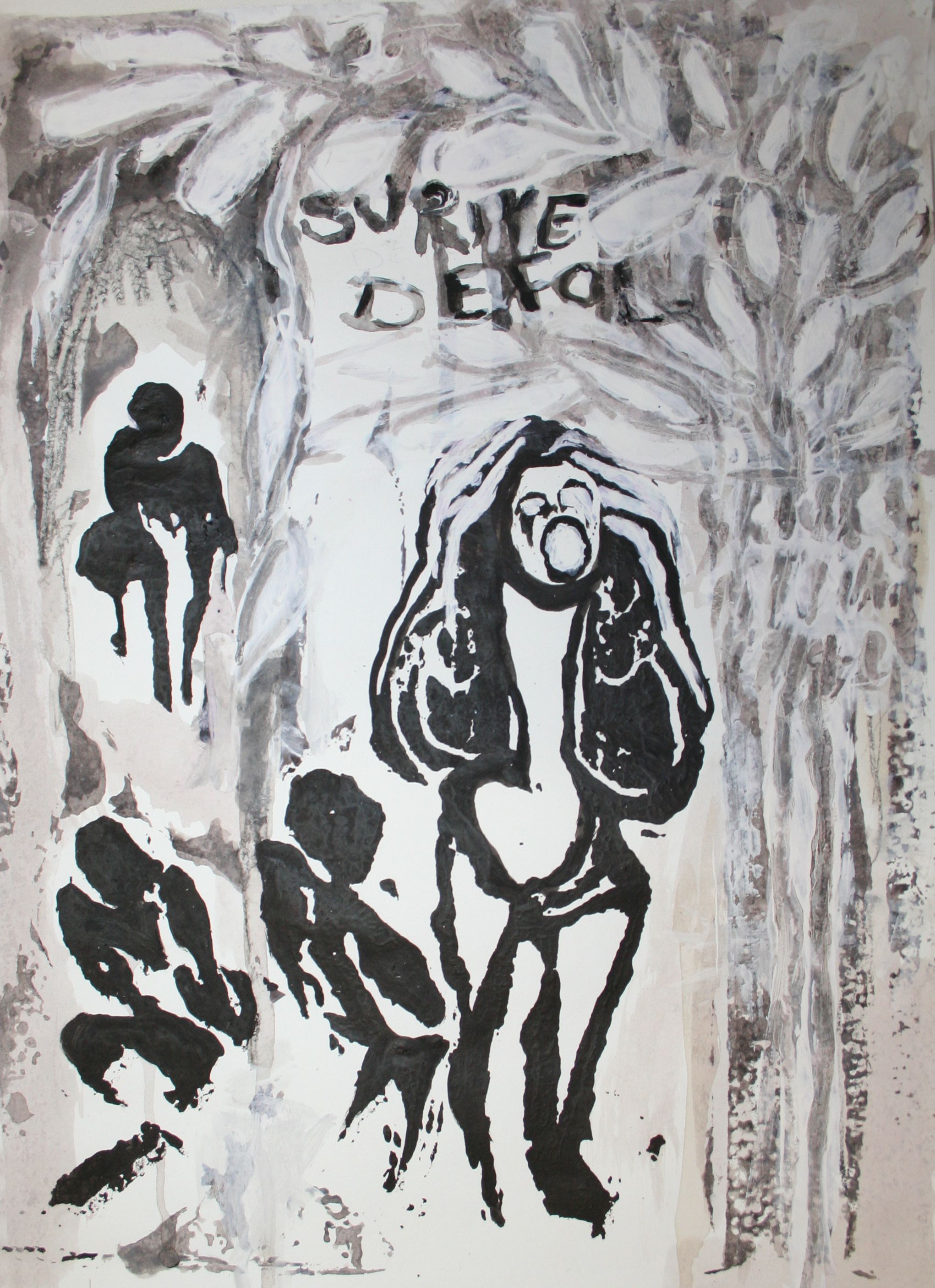
Sara – Survive or Fall
Survival and downfall held simultaneously
Figures move through a dense forest of marks: a hunched woman fleeing, smaller silhouettes collapsing behind her, another body fading into the trees. The words “Survive / Defo[l]l” hover like an unfinished verdict. The drawing holds Sara’s story of flight from Eastern Ghouta to Jordan—cold nights, children walking through darkness, tents in Za’atari—and the ongoing struggle in Amman, where safety and exhaustion, gratitude and despair, coexist in the same cramped rooms.
VIEW⤢
Falak – Guardians and Absences
A central figure rises above clustered bodies, lines radiating like both branches and veils. Around her, faces blur into one another, half haloed, half erased. The image reflects Falak’s journey from teacher and protester in Raqqa to organiser in exile and, later, participant in constitutional debates. Authority here is not pure power; it is weighted by grief for her kidnapped sons, by the women she stands alongside, and by the fragile institutions emerging from ruins.
VIEW⤢
Ahmed / Khaleed – The Interrupted Self
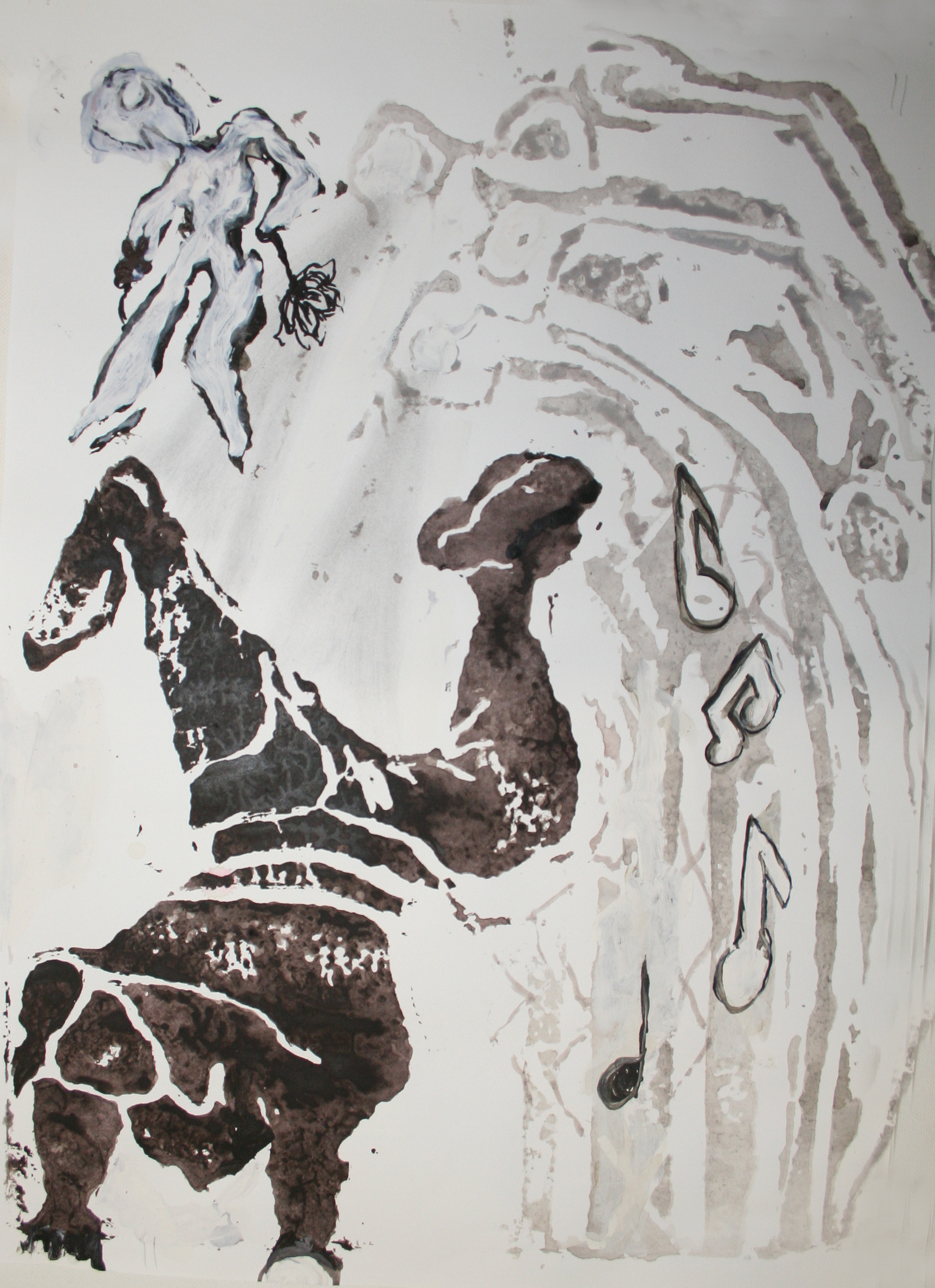
A man sits at an instrument or table, absorbed in making something, while a small spectral figure above looks away toward another place. Musical notes drift through a washed, vertical background, as if sound were moving through walls and borders. This ambiguity allows the image to speak to both Ahmed and Khaleed—men whose lives were halted in cells, forests, and detention centres, while another version of themselves, the one with plans and projects, seems to float just out of reach.
VIEW⤢
Sherko / Mahmoud – After the Mountain
A cluster of figures huddles together inside a boat like shape, faces open and anxious under a star strewn sky. The composition evokes both the 2014 Yazidi flight from Shengal and the repeated displacements of Shabak communities across northern Iraq. Sherko and Mahmoud carry memories of escape, camps, and unreturned dead, while trying to study, organise, and build media platforms. The drawing sits between collective trauma and tentative beginnings, a vessel that is both refuge and reminder of all that has been lost.
Artist Spotlight

Solar Quilombola

Digital illustration — Afro-Indigenous cosmovision
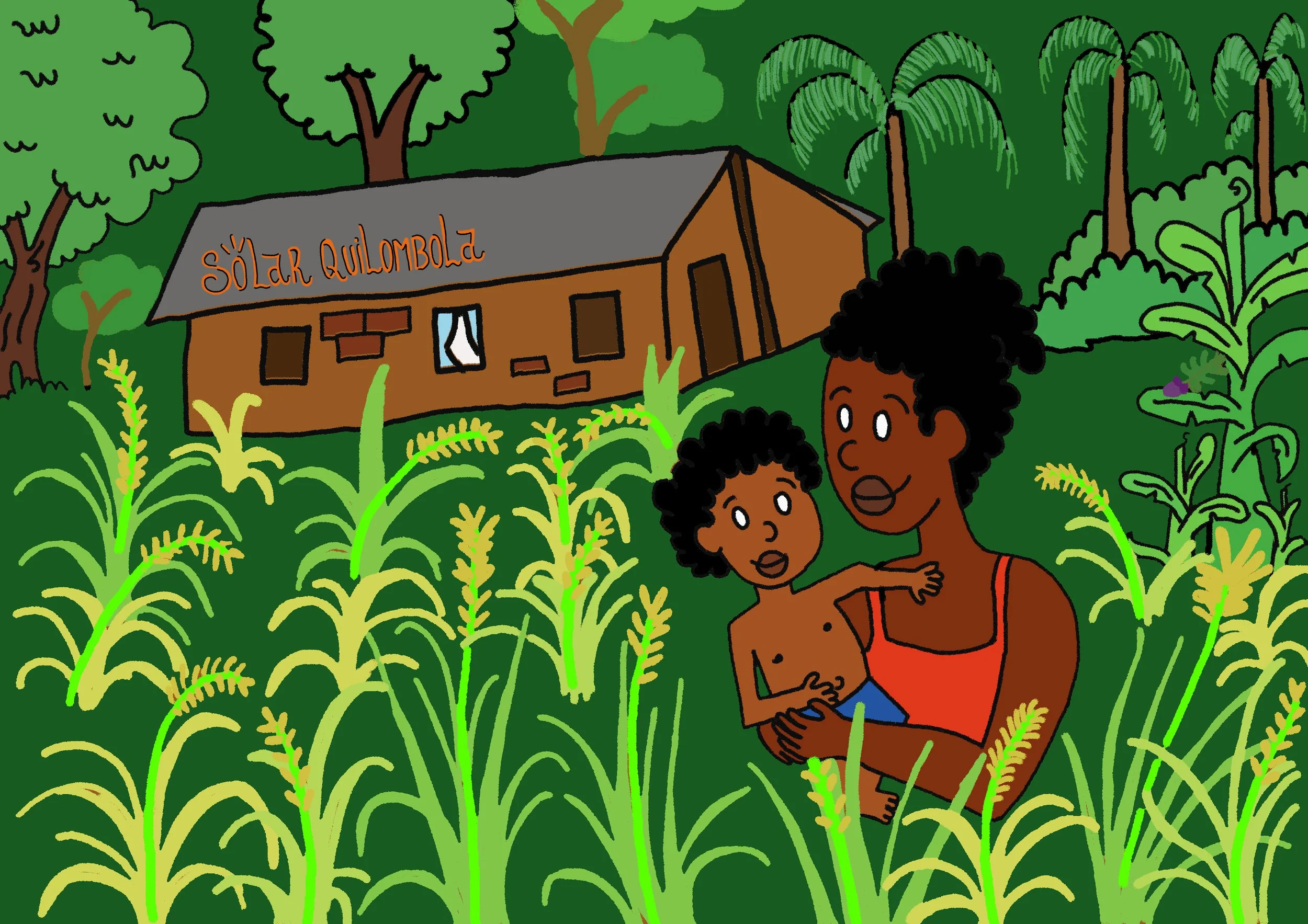
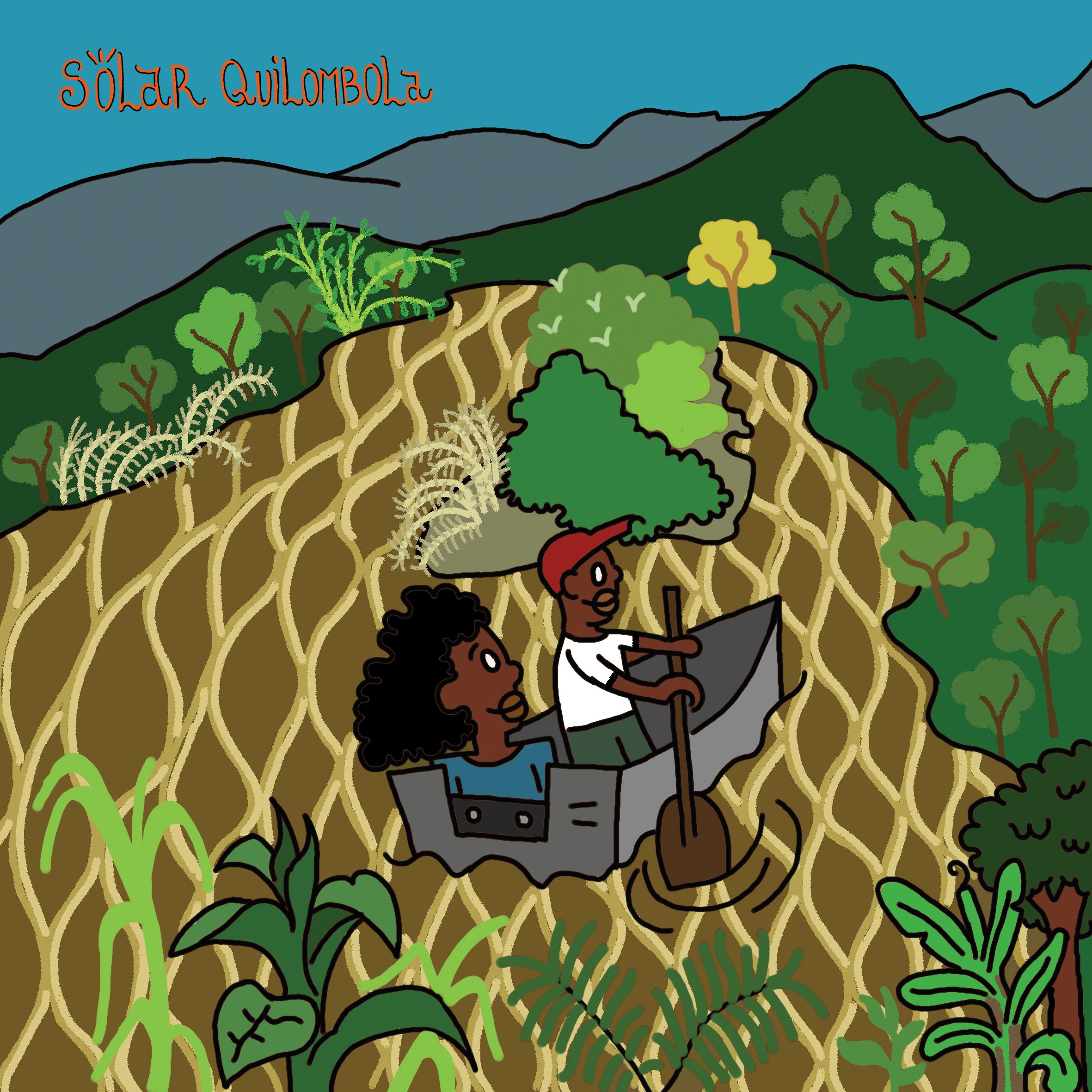
Solar Quilombola is a Brazilian artistic collective whose visual language draws on Afro-Indigenous cosmovision, quilombola territorial memory, and the living knowledge systems of forest communities threatened by climate change and land dispossession.

Their illustrations treat the land not as backdrop but as protagonist — rooted, sentient, generous, and endangered.
VIEW⤢
Movimento dos Ameaçados por Barragens no Vale do Ribeira (MOAB)
This image honours the Movement of People Threatened by Dams in the Ribeira Valley. Figures cluster around a river that has been both lifeline and site of dispute, while banners and patterns recall marches and assemblies. The work situates resilience in collective struggle—people facing slow violence together rather than in isolation.
VIEW⤢
Caminhos da Roça
Paths cross a patchwork of fields, forests, and waterways, traced by people moving between home, market, and commons. The illustration honours everyday labour—planting, harvesting, caring—as a political act. These ‘caminhos da roça’ are the routes through which communities maintain autonomy despite state and corporate pressures.
VIEW⤢
Futuro Ancestral
Children and elders share space beneath a canopy of leaves and constellations. Futuro Ancestral imagines the future as something built with ancestral guidance—walking forward with those who came before. The work insists that any just ecological transition must centre the time of quilombola and Indigenous communities. The tree is not metaphor. In many Afro-Indigenous cosmologies, the forest is a community of persons — beings with will, history, and the capacity to suffer. This image insists on that understanding: the tree is the oldest resident, the most reliable witness, the one whose memory runs deepest into the earth.
VIEW⤢
Oxum
“Oxum” depicts the Afro-Brazilian orixá of fresh waters, fertility, and beauty, her presence flowing through a landscape of rivers and yellow tones. The piece reclaims spiritual knowledge as environmental defence, showing how devotion to water becomes an embodied refusal of its contamination and enclosure.
VIEW⤢
Rede de Comunicadores do Fórum dos Povos e Comunidades Tradicionais
This piece celebrates the network of communicators within the Forum of Traditional Peoples and Communities. Radios, microphones, and digital devices link territories across distance, showing communication as a tool of self representation and mutual defence. The artwork underscores that storytelling is itself a frontline of resilience.
Section 03

Listening to Resilience

Music in this exhibition does not illustrate resilience from the outside; it inhabits it. Through rhythm, voice, improvisation, and atmosphere, these works register resilience as tension, movement, memory, and return.
Composition – Errante by Alejandro Picchetti

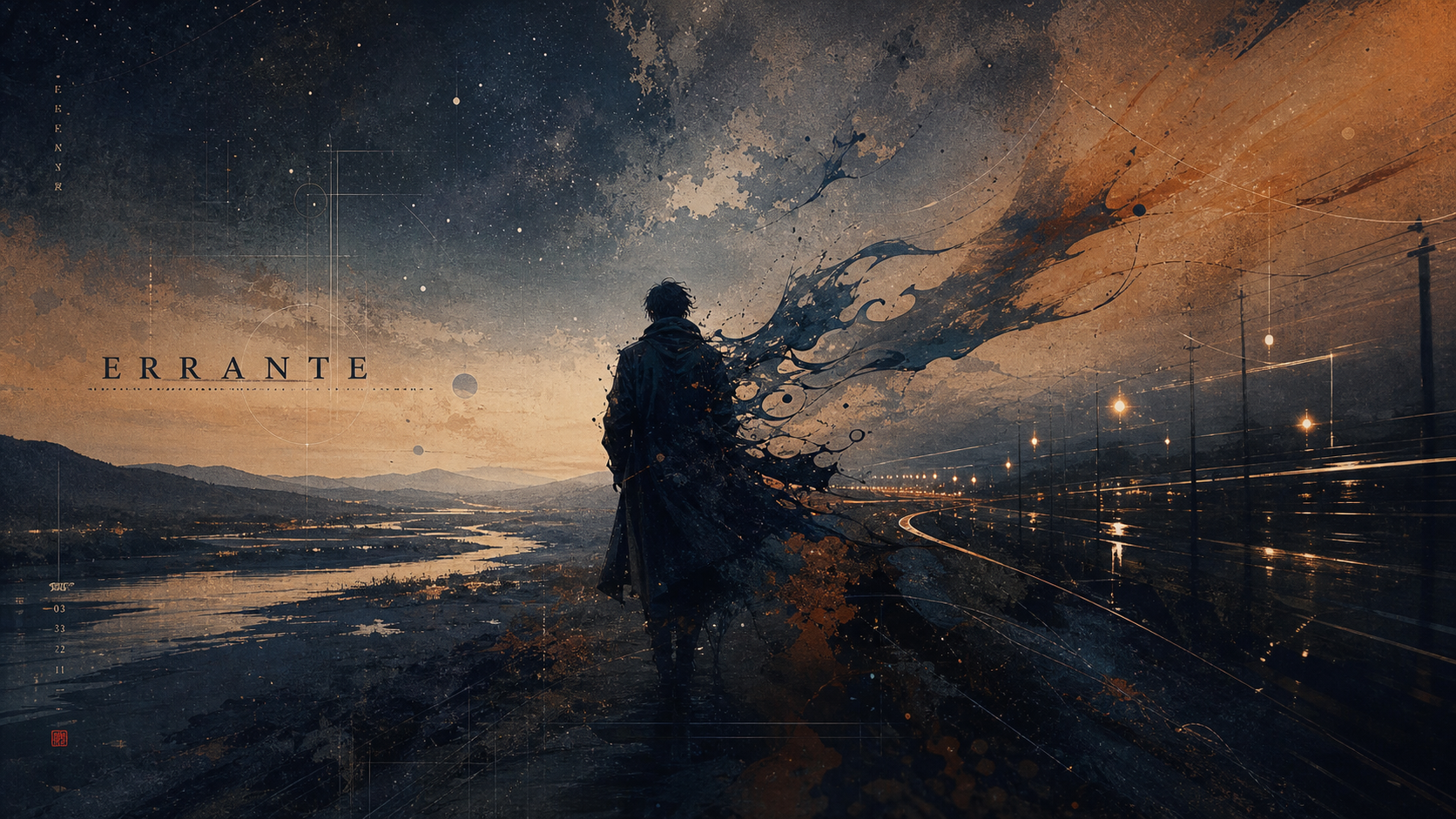
Errante: Drift, memory, persistence

This composition approaches resilience as movement, uncertainty, and persistence. It unfolds as a sonic meditation on drift, memory, and the search for orientation without closure. The Spanish word "Errante" refers to someone who is constantly on the move, seeking new horizons, without a predetermined destination. Along his journey, the voyager accumulated experiences that shape him and which he will look back on with nostalgia at the end of his path.
Alejandro Picchetti — Argentinian, based in Santiago Chile since 2002, an information technology engineer, musician and composer whose career weaves together music technology and artistic sensitivity. As a composer and performer, his musical roots lie in jazz, yet his work has evolved into an exploration of the traditional sounds of the Río de la Plata.
Section 04

Performance

Performance in this exhibition registers resilience as presence, voice, and movement. These works inhabit the body as a site of both rupture and resistance, giving form to struggle without reducing it to spectacle.
▶
São Sebastião Community Rap

Voice, urgency, witness Contributed by UNICAMP

After the 2023 landslides in São Sebastião on the coast of São Paulo state—one of the deadliest climate disasters in recent Brazilian history—this rap performance emerged from within the affected community. It is not a report; it is a reckoning with the disaster, with the institutional failures that made it worse, and with the community’s own capacity to survive and speak.

Conta Gotas approaches resilience through voice, urgency, and witness, giving sonic form to pressure, struggle, and the insistence on speaking from within difficult conditions. The title, Conta Gotas, means both "drop counter" and "dropper" — the device that releases medicine one drop at a time.
Section 05

Tasting Memory

Choose What to Taste
▶

A Table as a Threshold

Tasting Memory is an interactive documentary exploring how Syrian culinary practices were transformed — and transformative — through migration into Türkiye. Recipes open into personal histories. Navigate the branches and follow the flavours.

Through recipes, voices, and shared culinary practices, the work shows that resilience is not only expressed through image and sound, but also through taste, ritual, and the act of preparing food together.

Placed within the exhibition, Tasting Memory expands the meaning of resilience by showing how everyday practices — cooking, remembering, sharing, hosting — become forms of care, adaptation, and cultural persistence.
Co-created by Susan Rottmann, Zeynep Merve Uygun, Darya Mahçup, and Yousef Saleh and family, the work uses food as sensory memory and cultural continuity.
Section 06

Stories of Continuing: Voices from the Field

Stories of Continuing gathers short kino eye videos from the PHOENIX project’s “My Resilience Story” series, filmed in different parts of the world. Each piece stays close to one person’s voice, following their strategies for enduring crisis, navigating climate change, and remaking everyday life. Together, these stories invite viewers to see resilience as something spoken, sung, and embodied in homes, streets, forests, religious sites, and camps.

ResART clusters these stories into three constellations: “Living through disruption”, “Holding through relation”, and “Imagining what comes next”.

Why these stories matter?

In this short explainer, Jozef G. Cetrez situates the kinoeye stories within the wider PHOENIX project, highlighting why listening closely to individual experiences of climate and displacement is crucial. The video introduces key questions about resilience, vulnerability, and justice that echo across the testimonies that follow.
▶
Explainer Video by Jozef G. Cetrez

Living through disruption

▶
Antonio Prada – Stories of Climate Migrants in Argentina
A fisherman from Villa Constitución describes abandoning riverside homes after repeated floods and droughts. His testimony links the climate crisis and an extractivist development model to disrupted livelihoods, food insecurity, and the need to sleep in canoes when land itself becomes unreliable.
▶
İkitelli – Work in the Factory
Set in Istanbul’s İkitelli district, this story follows a Syrian worker through long shifts in workshops and factories. It traces how exhausting, often exploitative labour still becomes a way to sustain relatives and keep children in school, turning precarious wage work into a form of everyday care and responsibility.

Holding through relation

▶
Lourdiannis Maíz – Venezuela / Chile
Lourdiannis, a chemist-pharmacist and belly dancer, reflects on migrating from Venezuela to Chile. She speaks about grief for everyday family contact and, at the same time, the new role she plays as a key supporter of relatives back home, finding personal and professional growth in the host country.
▶
Daniel – Migration from Venezuela to Chile
Daniel, a cook from Venezuela, recounts leaving a “Caribbean” lifestyle and adapting to Chile’s cultural and psychological demands. He emphasises focusing on positives as a shared strategy among Venezuelans to protect mental health and sustain one another through uncertainty.

Imagining what comes next

▶
Enes – Growing Up in Between
Enes, a Syrian child growing up in Turkey, talks about school, friends, and the futures he imagines—sometimes in Turkey, sometimes elsewhere. His story reveals how children carry multiple maps in their heads at once, learning to navigate languages, expectations, and dreams that cross more than one country.
▶
Cindy – Dreams for the Future in Brazil
Cindy, a Venezuelan migrant in Rio de Janeiro, talks about her dreams for the future in Brazil. Her story balances the hardships of migration with an insistence on aspiration, imagining education, work, and belonging in a country that is still becoming home.
Section 07

Leave a Response

We invite you to add your voice to this assemblage of resilience.
Share a memory, a story, or a reflection on what these works have opened for you.

Credits

• Curators Soner Barthoma and Susan Rottmann • Web implementation Serkis C. Kurumlu • Participating artists Nahrin Malki (artwork / illustrations), Solar Quilombola (digital illustrations), Alejandro Picchetti (composition, Errante), Rap performance (Conta Gotas) • Kinoeye stories participants in Brazil, Chile, Argentina, and Türkiye. • With special thanks to the late Margarita Olivera, Leticia Pereira, Corina Demarchi, Paula Esposel, Yasmin Haddad, Vivian Braga, Lilana Acero, Pablo Zuleta Pastor and colleagues at UNICAMP • Explainer video Jozef G. Cetrez and A. Onver Cetrez • Tasting Memory Susan Rottmann, Zeynep Merve Uygun, Darya Mahçup and Yousef Saleh and family.

Our deepest thanks go to all artists, storytellers, community members who shared their experiences, as well as to our project partners who made this exhibition possible.

ResART is produced within the Belmont Forum–funded PHOENIX project.
✕
0
Skip to Content
Phoenix
Home
Project
Team
Partners
All News
Publications
Stories
Tasting Memory
GIS Datasets
Phoenix
Home
Project
Team
Partners
All News
Publications
Stories
Tasting Memory
GIS Datasets
Home
Folder: ABOUT
Back
Project
Team
Partners
Folder: OUTPUTS
Back
All News
Publications
Stories
Tasting Memory
GIS Datasets

PHOENIX is funded by the Belmont Forum,  “Mobility & Migration CRA Call” by the following public funding organizations: The Scientific and Technological Research Council of Türkiye (TÜBİTAK), Swedish Research Council for Environment, Agricultural Sciences, and Spatial Planning (FORMAS), Inter-American Institute for Global Change Research (IAI), The Austrian Science Fund (FWF), São Paulo Research Foundation (FAPESP), and National Research Foundation (NRF). Project Duration: 2023-2026

phoenix.climatemobilities@gmail.com


Contact us